
On this page 40 sections
- What Is SEO (Search Engine Optimization)?
- How Does SEO Work?
- Benefits of SEO
- What Is AEO (Answer Engine Optimization)?
- How Does Answer Engine Optimization Work?
- Benefits of AEO
- What Is GEO (Generative Engine Optimization)?
- How Does Generative Engine Optimization Work?
- Benefits of GEO
- AEO vs SEO vs GEO: Key Differences
- GEO vs SEO: Which Is More Important?
- SEO vs GEO Comparison
- Should Businesses Replace SEO With GEO?
- AEO vs SEO: How Are They Different?
- Main Differences Between AEO and SEO
- How Do SEO, AEO, and GEO Work Together?
- Step 1: Build a Strong SEO Foundation
- Step 2: Optimize Content for Answers
- Step 3: Improve Generative AI Visibility
- Step 4: Strengthen Your Brand Authority
- Step 5: Measure and Improve Performance
- 7 Best Practices to Improve AI Search Visibility
- 1. Create Helpful and Original Content
- 2. Target Conversational Search Queries
- 3. Improve Internal Linking
- 4. Build High-Quality Backlinks
- 5. Use Structured Data Correctly
- 6. Keep Your Website Technically Accessible
- 7. Monitor Your Brand Across AI Platforms
- SEO, AEO, and GEO: Which Strategy Should Your Business Choose?
- How Can Sizaria Technologies Help With SEO, AEO, and GEO?
- Frequently Asked Questions (FAQs)
- 1. What is the difference between AEO, SEO, and GEO?
- 2. Is GEO replacing SEO?
- 3. What is better, AEO or SEO?
- 4. How can I improve my website's visibility in ChatGPT?
- 5. Does GEO help with Google AI Overviews?
- 6. What is AI Search Visibility?
- 7. Can small businesses benefit from AEO and GEO?
- Final Thoughts: The Future of Search Is Beyond Traditional SEO
Search engines are changing how people discover businesses, products, and information online. Traditional Google searches are no longer the only way customers find answers. Today, people also use ChatGPT, Google AI Overviews, Gemini, and other AI-powered platforms to research products, compare services, and make purchasing decisions.
This change has introduced three important digital marketing concepts: SEO, AEO, and GEO.
But what is the difference between AEO vs SEO vs GEO? Are these three separate strategies, or do they work together?
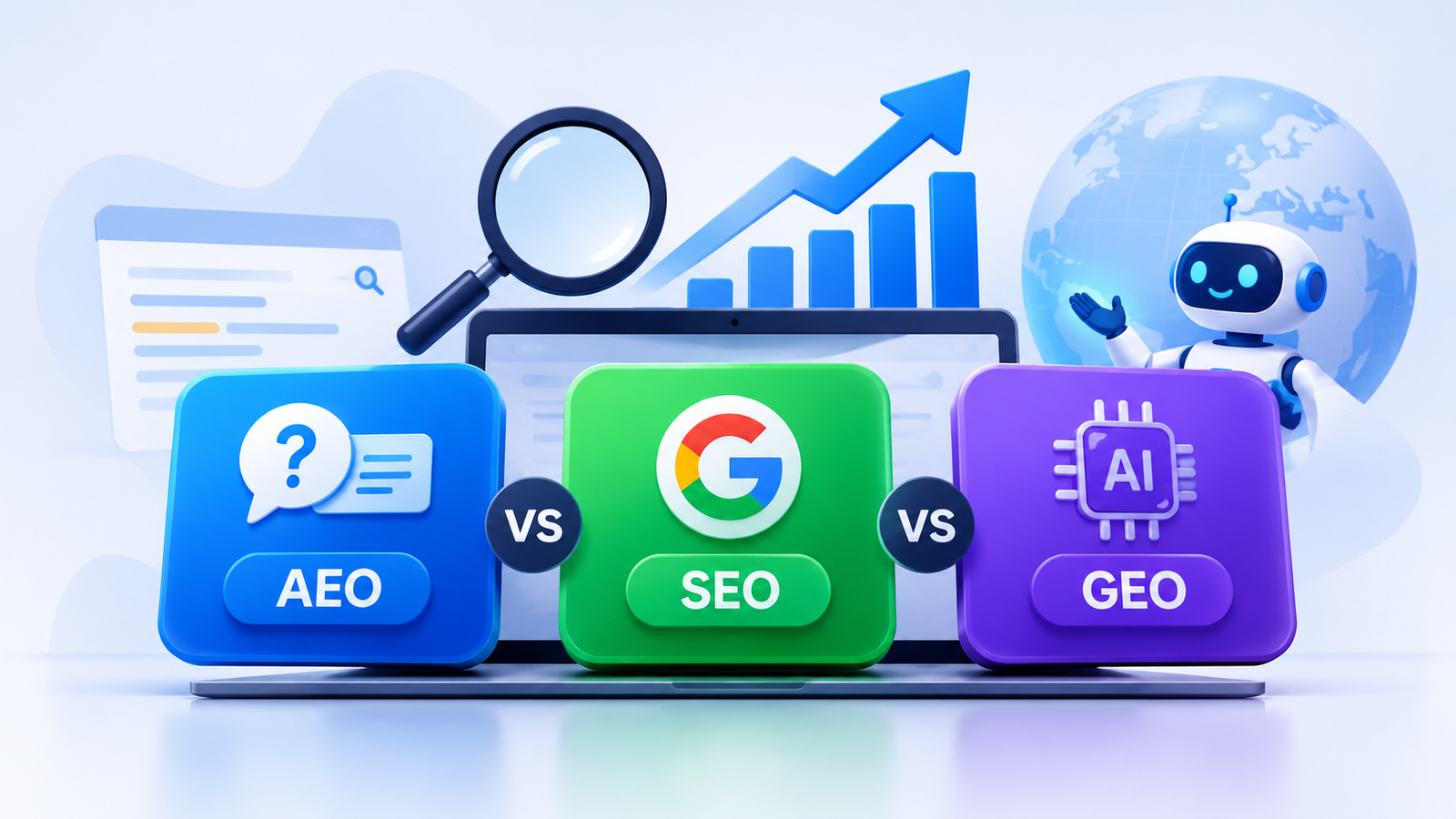
SEO (Search Engine Optimization) focuses on improving website rankings in traditional search engines. AEO (Answer Engine Optimization) focuses on making content easy for answer engines to understand and use when responding to questions. GEO (Generative Engine Optimization) focuses on improving a brand's visibility and potential citations in AI-generated responses.
For businesses, understanding these strategies is becoming increasingly important. A website that only targets traditional Google rankings may miss opportunities to reach customers who use AI platforms to discover information.
In this guide, we will explain how SEO, AEO, and GEO work, compare their differences, and explore how businesses can combine all three to improve online visibility.
What Is SEO (Search Engine Optimization)?
Search Engine Optimization (SEO) is the process of improving a website's visibility in organic search engine results. Its primary goal is to help relevant web pages appear when people search for information, products, or services.
For example, when someone searches for "SEO agency in Lahore," Google displays websites that its systems consider relevant and useful for that search.
Businesses use SEO to attract organic traffic without paying for every website visit.
How Does SEO Work?
SEO involves several activities that help search engines discover, understand, and evaluate website content.
The main components include:
1. On-Page SEO
On-page SEO improves individual website pages through:
- Keyword research and placement
- Optimized page titles and meta descriptions
- Proper H1, H2, and H3 headings
- Internal linking
- Image optimization and alt text
- Helpful, relevant website content
2. Technical SEO
Technical SEO ensures search engines can access and understand your website.
Important activities include:
- Improving website loading speed
- Fixing crawling and indexing problems
- Implementing XML sitemaps
- Optimizing mobile responsiveness
- Fixing broken links and redirects
- Implementing appropriate structured data
3. Off-Page SEO
Off-page SEO focuses on improving your website's reputation and authority through activities such as:
- Earning quality backlinks
- Digital PR
- Brand mentions
- Relevant business directories
- Industry partnerships
Benefits of SEO
- Increases organic website traffic.
- Improves visibility on Google and Bing.
- Helps businesses attract potential customers.
- Builds brand awareness and credibility.
- Supports long-term lead generation.
- Reduces dependence on paid advertising.
Businesses looking to improve their organic search performance can explore Sizaria Technologies' SEO services.
What Is AEO (Answer Engine Optimization)?
Answer Engine Optimization (AEO) is the process of structuring and improving website content so answer-focused platforms can understand it and potentially use it to answer users' questions.
Unlike traditional searches, where users often browse multiple websites, answer engines aim to provide direct responses.
For example, someone might ask:
"What is the difference between SEO and GEO?"
An answer engine may provide a short explanation, supported by relevant sources or website links.
AEO aims to make your content clear, relevant, trustworthy, and useful enough to be considered for these answers.
How Does Answer Engine Optimization Work?
AEO focuses on understanding the questions people ask and providing direct, helpful answers.
Its key elements include:
1. Question-Based Content
Create content around real questions your target audience searches for.
Examples:
- What is SEO?
- How does answer engine optimization work?
- Why is AI search visibility important?
- What is the difference between AEO and SEO?
2. Clear and Direct Answers
Provide concise answers immediately after relevant headings. Avoid unnecessary introductions before answering the question.
3. Structured Content
Use descriptive headings, bullet points, comparison tables, and FAQs to make information easier to understand.
4. Relevant Structured Data
Use appropriate schema markup when it accurately represents visible page content. Examples include Article, Organization, BreadcrumbList, and relevant product or service schemas.
Schema can help search engines understand your content, but it does not guarantee answer placement or AI citations.
5. Trust and Accuracy
Support important claims with reliable references, real examples, relevant expertise, and updated information.
Benefits of AEO
- Improves the clarity of website content.
- Helps target question-based searches.
- Creates opportunities for featured snippets and AI-generated answers.
- Supports visibility across answer-focused search experiences.
- Helps potential customers discover your expertise.
What Is GEO (Generative Engine Optimization)?
Generative Engine Optimization (GEO) is the process of improving a brand's chances of being discovered, mentioned, or cited in AI-generated responses.
Generative AI platforms can interpret questions, retrieve relevant information, and generate responses using information from multiple sources.
Examples include:
- ChatGPT Search
- Google AI Overviews
- Google AI Mode
- Gemini
- Microsoft Copilot
- Perplexity
Imagine a business owner asking ChatGPT:
"Which digital marketing agencies can help my company improve SEO and AI search visibility?"
If your website has relevant services, useful content, a clear brand identity, and credible online references, it may have a better opportunity to be considered by AI systems.
However, appearing in an AI-generated response is not guaranteed.
How Does Generative Engine Optimization Work?
GEO focuses on making your brand and website information easier for AI-powered discovery systems to understand, evaluate, and reference.
Important GEO activities include:
1. Publish Original and Valuable Content
Create detailed articles, practical guides, comparisons, case studies, and industry insights that offer something useful beyond information already available online.
2. Build Brand Authority
Develop a consistent online presence through:
- Relevant industry publications
- Quality backlinks
- Genuine brand mentions
- Expert contributions
- Accurate company information
3. Improve Content Structure
Organize information with descriptive headings, short explanations, relevant tables, and supporting references.
4. Strengthen Entity Recognition
Maintain consistent brand information across your website, business profiles, social platforms, and relevant third-party sources.
5. Monitor AI Search Visibility
Check whether your business is mentioned or cited in relevant AI-generated answers. Monitor competitors and identify topics where your brand is missing.
Benefits of GEO
- Creates opportunities for AI-driven brand discovery.
- Helps businesses build visibility beyond traditional search results.
- Supports brand recognition in generative AI platforms.
- Identifies new content and authority-building opportunities.
- Can help attract potential customers researching services through AI.
AEO vs SEO vs GEO: Key Differences
Although SEO, AEO, and GEO share the goal of improving online visibility, they focus on different discovery experiences.
The following table explains the differences.
| Comparison | SEO | AEO | GEO |
|---|---|---|---|
| Full Form | Search Engine Optimization | Answer Engine Optimization | Generative Engine Optimization |
| Main Goal | Improve search rankings | Provide direct answers | Improve AI-generated response visibility |
| Primary Focus | Organic search results | Question-based answers | AI discovery and citations |
| Platforms | Google, Bing | Featured snippets and answer engines | ChatGPT, Gemini, Perplexity, AI Overviews |
| Content Style | Helpful, keyword-focused content | Clear question-and-answer content | Original, contextual and authoritative content |
| Main Strategy | Technical, on-page and off-page SEO | Direct answers and structured information | Brand authority, original content and AI visibility |
| Success Measurement | Rankings, impressions, clicks | Answer appearances and relevant search features | AI mentions, citations and referral traffic |
The important takeaway: SEO helps people find your website through search results, AEO helps your content become a useful answer, and GEO focuses on making your brand discoverable in generative AI experiences.
GEO vs SEO: Which Is More Important?
GEO vs SEO is one of the most important comparisons for businesses adapting to AI-powered search.
Traditional SEO remains essential because search engines still rely on crawling, indexing, relevance, and quality signals to discover and evaluate content.
GEO adds another layer of consideration: how AI systems discover, interpret, and reference information when generating responses.
Consider this example:
A company publishes an article about website security.
With SEO, the company optimizes the article to rank for keywords such as "website security services" and "website vulnerability scanning."
With GEO, the company also focuses on providing original security insights, clear explanations, relevant evidence, and credible brand information that could make its content useful as a source in AI-generated responses.
SEO vs GEO Comparison
| Factor | SEO | GEO |
|---|---|---|
| Primary objective | Search engine rankings | AI-generated visibility |
| Discovery method | Search engine results | AI-assisted information discovery |
| Keyword strategy | Search queries and search intent | Topics, entities and conversational questions |
| Content approach | Search-focused helpful content | Original, contextual and reference-worthy content |
| Authority building | Backlinks and reputation | Credible mentions, sources and reputation |
| Performance tracking | Google Search Console and Analytics | AI mentions, citations and referral analysis |
Should Businesses Replace SEO With GEO?
No. Businesses should not abandon SEO to focus only on GEO.
Google's official guidance confirms that foundational SEO practices remain relevant for AI search experiences. Websites still need to be crawlable, indexable, useful, and technically accessible.
The better approach is to combine traditional SEO with relevant AEO and GEO practices.
AEO vs SEO: How Are They Different?
AEO vs SEO is another important comparison because both strategies help users discover information through search experiences.
SEO primarily focuses on improving a website's organic search visibility, while AEO focuses on making content suitable for direct answers.
For example, consider the question:
"How much does website development cost?"
An SEO strategy might target the keyword "website development cost" and optimize an article around it.
An AEO strategy would also provide a clear, direct answer, explain the factors affecting the cost, and use headings to answer related questions.
Main Differences Between AEO and SEO
| Factor | SEO | AEO |
|---|---|---|
| Focus | Organic search rankings | Direct answers |
| Content structure | Topic-focused pages | Question-and-answer format |
| Search intent | Informational, commercial and transactional | Primarily question-based informational intent |
| Optimization | Keywords, technical SEO and backlinks | Clear answers, structure and relevance |
| Measurement | Rankings, clicks and impressions | Answer visibility and relevant answer features |
Can AEO work without SEO?
AEO and SEO are closely connected. Content that is useful, accessible, well-structured, and properly indexed has a stronger foundation for both traditional search and answer-focused discovery.
How Do SEO, AEO, and GEO Work Together?
SEO, AEO, and GEO should be treated as complementary strategies rather than competing marketing techniques.
A business that combines all three can build a stronger online presence across traditional search engines and emerging AI-powered discovery platforms.
Here is how they can work together.
Step 1: Build a Strong SEO Foundation
Start with technical SEO, keyword research, quality content, internal linking, mobile optimization, and a clear website structure.
Your website should be accessible to search engines and provide a good experience for visitors.
Step 2: Optimize Content for Answers
Identify questions your customers ask and answer them clearly.
Use:
- Question-based headings
- Short, direct explanations
- Relevant FAQs
- Comparison tables
- Step-by-step guides
Step 3: Improve Generative AI Visibility
Develop original content that demonstrates expertise and provides useful information.
Build a consistent brand presence and earn relevant mentions from credible websites.
Step 4: Strengthen Your Brand Authority
Ensure your business information is accurate and consistent.
Publish case studies, service pages, educational articles, and industry insights that explain what your business does and whom it serves.
Step 5: Measure and Improve Performance
Monitor traditional search performance and AI visibility separately.
Use Google Search Console and Google Analytics for website performance. Review relevant AI platforms to understand when your business appears in generated answers and which sources they reference.
7 Best Practices to Improve AI Search Visibility
Businesses that want to improve AI search visibility should focus on creating useful, reliable, and accessible information.
Here are seven practical recommendations.
1. Create Helpful and Original Content
Avoid publishing articles that simply repeat information available on other websites. Include useful examples, expert explanations, original insights, and practical recommendations.
2. Target Conversational Search Queries
People often ask AI platforms complete questions instead of entering short keywords.
Include relevant questions such as:
- What is the best SEO strategy for small businesses?
- How can a website appear in ChatGPT answers?
- Is GEO better than SEO?
- How does answer engine optimization work?
3. Improve Internal Linking
Connect related blogs, service pages, and important website resources.
Internal links help visitors discover additional information and help search engines understand how your website content is connected.
4. Build High-Quality Backlinks
Earn links from relevant, credible websites through useful content, industry contributions, digital PR, and genuine partnerships.
Avoid buying large numbers of low-quality links.
5. Use Structured Data Correctly
Implement relevant structured data that accurately describes the visible content on your pages.
Do not add irrelevant schema or expect schema markup alone to produce AI citations.
6. Keep Your Website Technically Accessible
Check:
- Website indexing
- Robots.txt settings
- XML sitemap
- Mobile usability
- Page loading performance
- Broken internal links
- Canonical URLs
7. Monitor Your Brand Across AI Platforms
Search for your business name and relevant service queries on ChatGPT, Gemini, and Perplexity.
Record which brands appear, which websites are cited, and which topics create opportunities for your business.
SEO, AEO, and GEO: Which Strategy Should Your Business Choose?
The right approach depends on your business objectives, target customers, and existing online visibility.
| Business Goal | Recommended Strategy |
|---|---|
| Increase Google organic traffic | SEO |
| Improve visibility for question-based searches | AEO + SEO |
| Increase brand visibility in AI responses | GEO + SEO |
| Generate leads through search engines | SEO + AEO |
| Build long-term visibility across search platforms | SEO + AEO + GEO |
| Improve brand discovery through AI | GEO + AEO |
For most businesses, combining these approaches provides a more balanced strategy.
If your website has little organic visibility, start with SEO fundamentals. Once your content and technical foundation are strong, expand into answer-focused content and generative AI visibility.
How Can Sizaria Technologies Help With SEO, AEO, and GEO?
At Sizaria Technologies, we help businesses strengthen their digital presence through website development, search engine optimization, and digital marketing solutions.
As search behavior evolves, businesses need more than traditional keyword optimization. They need websites that are technically sound, content that answers customer questions, and a consistent brand presence across online platforms.
Our digital solutions include:
SEO Services
Improve organic search visibility through technical SEO, keyword research, on-page optimization, content strategy, and link-building activities.
AEO Optimization
Structure website content around customer questions, relevant topics, and clear answers to improve answer-focused search visibility.
GEO Optimization
Strengthen brand information, content authority, and AI search visibility to create more opportunities for discovery across generative AI platforms.
Web Design and Development
Build user-friendly, responsive websites with clear navigation, strong technical foundations, and conversion-focused layouts.
Explore our SEO agency services in Lahore or visit our complete range of digital services.
Whether you are a startup, small business, or established company, our goal is to help you build a stronger online presence and attract relevant customers.
Frequently Asked Questions (FAQs)
1. What is the difference between AEO, SEO, and GEO?
SEO focuses on improving organic search rankings, AEO focuses on making content suitable for direct answers, and GEO focuses on improving a brand's visibility and potential citations in generative AI responses.
2. Is GEO replacing SEO?
No. GEO is not a replacement for SEO. Traditional SEO practices remain important for search engine discovery and many AI-powered search experiences. Businesses should combine both strategies.
3. What is better, AEO or SEO?
Neither is universally better. SEO is important for organic search visibility, while AEO helps make information useful for answer-focused searches. Combining both can support a wider discovery strategy.
4. How can I improve my website's visibility in ChatGPT?
Publish original and useful content, maintain accessible website pages, build brand credibility, provide accurate business information, and earn relevant references from trusted sources. However, no optimization method guarantees that ChatGPT will mention your website.
5. Does GEO help with Google AI Overviews?
GEO practices can support the discoverability and usefulness of content in generative AI experiences. Google states that its existing SEO fundamentals remain relevant for AI Overviews and AI Mode. There is no special GEO technique that guarantees inclusion.
6. What is AI Search Visibility?
AI Search Visibility describes how often and in what context a brand or website appears in responses generated by AI-powered platforms such as ChatGPT, Gemini, and Perplexity.
7. Can small businesses benefit from AEO and GEO?
Yes. Small businesses can create helpful niche-specific content, answer customer questions, maintain accurate business information, and build relevant online authority. These activities can create additional opportunities for online discovery.
Final Thoughts: The Future of Search Is Beyond Traditional SEO
The difference between AEO vs SEO vs GEO is not simply about three marketing terms. It reflects how online discovery is evolving.
SEO remains the foundation for organic search visibility. AEO helps businesses provide clear answers to customer questions, while GEO focuses on brand discovery and potential citations in generative AI experiences.
Businesses that invest in useful content, technical website improvements, brand authority, and a consistent digital presence will be better prepared for changes in search behavior.
Want to improve your website's visibility on Google and AI-powered search platforms?
Connect with Sizaria Technologies to explore SEO, AEO, GEO, and digital marketing solutions for your business.







Leave a comment